Something has shifted in the way political campaigns are run, and it happened faster than most people noticed. AI-generated political ads, cloned voices, fabricated video footage of real candidates saying things they never said, and synthetic rallies that never took place have all appeared in real election cycles over the past two years. This is not a distant hypothetical. It is already happening, and the pace is accelerating.
Oli and I have been watching this space closely, and every time we think we have a grip on how far it has gone, another story lands that pushes the boundary further. The technology is moving quicker than the laws designed to control it, and in a year when major elections are either ongoing or on the horizon across Europe and beyond, that gap matters enormously.
What AI-Generated Political Ads Actually Look Like in 2026
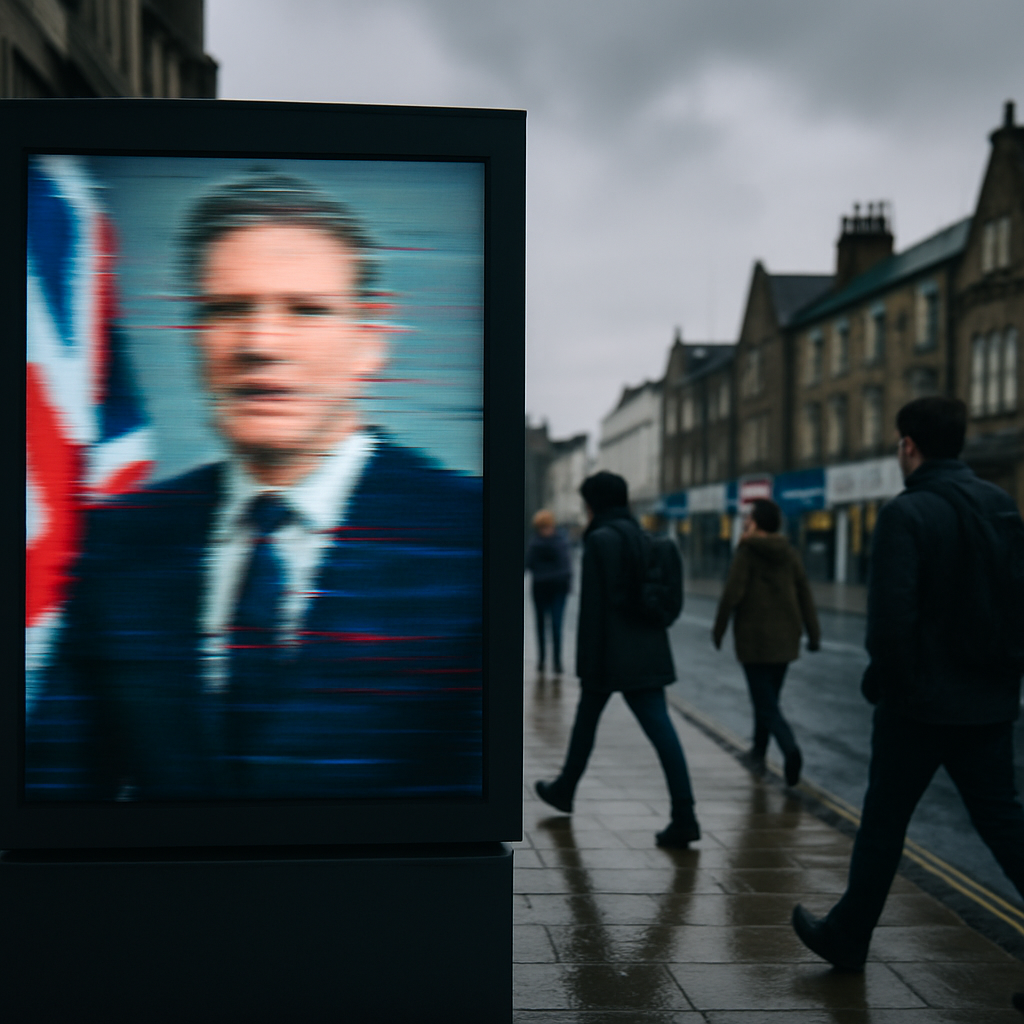
The term “deepfake” has become something of a catch-all, but the reality is more varied than a single word suggests. AI-generated political ads can take several forms. There are audio deepfakes, where a candidate’s voice is cloned and used to deliver a message they never recorded. There are video deepfakes, where a politician’s face is mapped onto another body or their lips are resynced to match fabricated speech. And there are entirely synthetic personas, computer-generated spokespeople who look completely real but do not exist at all.
In the 2024 Romanian presidential election, a viral TikTok campaign using AI-generated content helped push a relatively unknown far-right candidate to an unexpected first-round lead, prompting the Constitutional Court to annul the result entirely. It was one of the clearest examples yet of synthetic media directly influencing a democratic outcome. Closer to home, during the UK general election campaign of 2024, a fake audio clip purporting to feature Sir Keir Starmer berating Labour party staff circulated widely on social media before being debunked. The clip was crude by current standards. By 2026 standards, a convincing fake would be orders of magnitude harder to detect.
Why Elections Are Particularly Vulnerable to Synthetic Media
Elections operate on a compressed timeline. A piece of damaging content released 48 hours before polling day does not need to survive rigorous fact-checking. It simply needs to travel fast enough to plant doubt. That is the specific vulnerability that AI-generated political ads exploit. The correction rarely travels as far as the original lie.
Social media platforms are the primary distribution mechanism, and despite years of promises, their track records on removing synthetic political content remain patchy at best. Meta introduced a policy requiring disclosure on AI-generated political advertising across Facebook and Instagram, but enforcement is inconsistent and the rules only apply to paid ads, not organic posts shared by ordinary accounts. A convincing deepfake posted by a private individual and reshared thousands of times sits in a largely unregulated space.
There is also a psychological dimension that makes this particularly insidious. Research from University College London found that people who encounter a false claim are more likely to believe future versions of it, even after being told it was false. This is sometimes called the illusory truth effect, and AI-generated content is precisely engineered to trigger it at scale.
What Regulators in the UK and Europe Are Actually Doing
The regulatory picture is fractured. In the UK, the Electoral Commission has limited powers when it comes to digital content, and the Online Safety Act 2023, which came into force through 2024 and 2025, does not specifically address synthetic political media. Ofcom, which oversees the Act’s implementation, has consulted on rules around harmful content, but critics argue the provisions are too broad to be meaningfully applied to fast-moving deepfake scenarios during a live election.
The European Union’s AI Act, which is now being phased in across member states, does include provisions requiring disclosure when AI is used to generate content depicting real people. Under those rules, AI-generated political ads must carry clear labelling. Whether that labelling actually changes voter behaviour is another question entirely, and enforcement across 27 member states with varying levels of digital literacy is a serious logistical challenge.
The UK government has indicated it will look at further legislative steps, but progress has been slow. A cross-party group of MPs raised concerns in early 2026 about the lack of specific offences relating to election-targeted deepfakes, pointing to proposals that have stalled in committee. You can follow the Electoral Commission’s published guidance on this at electoralcommission.org.uk, though even they acknowledge the framework needs updating.
Can Technology Fight Back Against Synthetic Media?
Detection tools exist, but this is an arms race in which the offensive technology is currently winning. Companies like Sensity AI and Hive Moderation offer deepfake detection services, but their accuracy drops when synthetic content has been compressed through social media platforms, which is exactly how most people encounter it. The signal that gives away a deepfake often gets lost in the noise of a low-resolution share.
Content provenance systems offer some hope. The Coalition for Content Provenance and Authenticity (C2PA), backed by major tech firms including Adobe, Microsoft, and the BBC, is developing standards that attach verifiable metadata to digital files, showing their origin and any modifications made. If a video was shot on a camera that supports C2PA, its chain of custody can be traced. The problem is that this only works if the original content is captured by a C2PA-compliant device, and the metadata can be stripped when content is downloaded and reuploaded. It is a partial solution at best.
Some campaigns are now using pre-emptive disclosure, voluntarily publishing behind-the-scenes footage and raw audio to establish baseline authenticity for their candidate’s voice and appearance. It sounds counterintuitive, but it creates a reference point that makes fakes easier to challenge. It is worth noting that schools working on media literacy, for instance through a climate action plan for schools in the midlands, are increasingly incorporating digital literacy into broader civic education frameworks, recognising that the next generation of voters needs to understand how synthetic media works.
The Bigger Question Nobody Wants to Answer
Underneath all the technical detail sits a harder problem. If AI-generated political ads become indistinguishable from real ones, and if the public gradually absorbs the lesson that any video or audio of a politician might be fake, what happens to trust in political communication altogether? Some researchers call this the liar’s dividend: the mere existence of deepfake technology gives bad actors a plausible deniability defence. A real recording of a politician doing something wrong can now be dismissed as fabricated. The technology does not just create false content; it poisons the well for genuine content too.
That is the really unsettling part. Oskar and I keep coming back to it. The danger is not just the fakes that fool people. It is the real things that people stop believing. There is no easy legislative fix for a collapse in epistemic trust, and right now, the political will to take this seriously seems to arrive only after the damage is done.
Regulation will tighten. Detection technology will improve. Platforms will, eventually, be held more accountable. But election cycles do not pause for any of that. The voters going to polling stations across Europe this year are navigating a media environment that is fundamentally different from any that came before it, and most of them have no idea.
Frequently Asked Questions
What are AI-generated political ads and how do they work?
AI-generated political ads use machine learning tools to create synthetic audio, video, or images of real politicians saying or doing things they never actually did. The technology can clone voices from existing recordings and map faces onto different footage with increasing realism. They are produced quickly, cheaply, and can be distributed across social media within hours.
Are deepfake political videos illegal in the UK?
There is currently no specific UK law that criminalises deepfake political videos used in election campaigns. The Online Safety Act 2023 covers some harmful synthetic content but does not directly address fabricated political material. Campaigners and MPs have called for dedicated legislation, but as of 2026 it has not been passed.
How can you tell if a political video has been generated by AI?
Common signs include unnatural blinking, inconsistent lighting around the face, slightly off lip-sync, and audio that sounds subtly processed. However, the latest generation of AI tools produces output that is extremely difficult to detect without specialist software. Content provenance tools, like those developed by the C2PA coalition, can help verify authentic footage.
Which elections have already been affected by AI-generated content?
The 2024 Romanian presidential election is the most dramatic example, where AI-boosted synthetic campaigning contributed to the Constitutional Court annulling the first-round result. The 2024 UK general election also saw fake audio of Sir Keir Starmer circulating online. Similar incidents occurred in elections in Slovakia, Pakistan, and Bangladesh in 2024 and 2025.
What are social media platforms doing about AI political disinformation?
Meta requires paid political advertisers to disclose AI-generated content on Facebook and Instagram, while YouTube has mandatory disclosure policies for synthetic election-related videos. However, these rules largely apply to paid advertising and are inconsistently enforced, meaning organic sharing of deepfakes remains a significant unaddressed loophole.