
Walk into a market stall in Manchester, a seaside café in Whitby, or a car park in Bristol and you will increasingly see the same sign: Card payments only. No apology, no alternative, just a laminated rectangle quietly telling a chunk of the population they are no longer welcome to spend their money here. The UK’s shift toward a cashless society is accelerating faster than most people realise, and while it suits plenty of us just fine, for millions of others it is becoming genuinely frightening.
Britain is not alone in this trend, but we are moving at a pace that is leaving real people behind. According to the BBC, the number of free-to-use ATMs in the UK has fallen by over 10,000 since 2018, with rural communities and lower-income urban areas hit hardest. Cash payments accounted for only around 12% of all UK transactions in 2023, down from over 50% a decade ago. The direction of travel is unmistakable. The question nobody in government seems particularly keen to answer is: who gets left behind when physical money disappears?
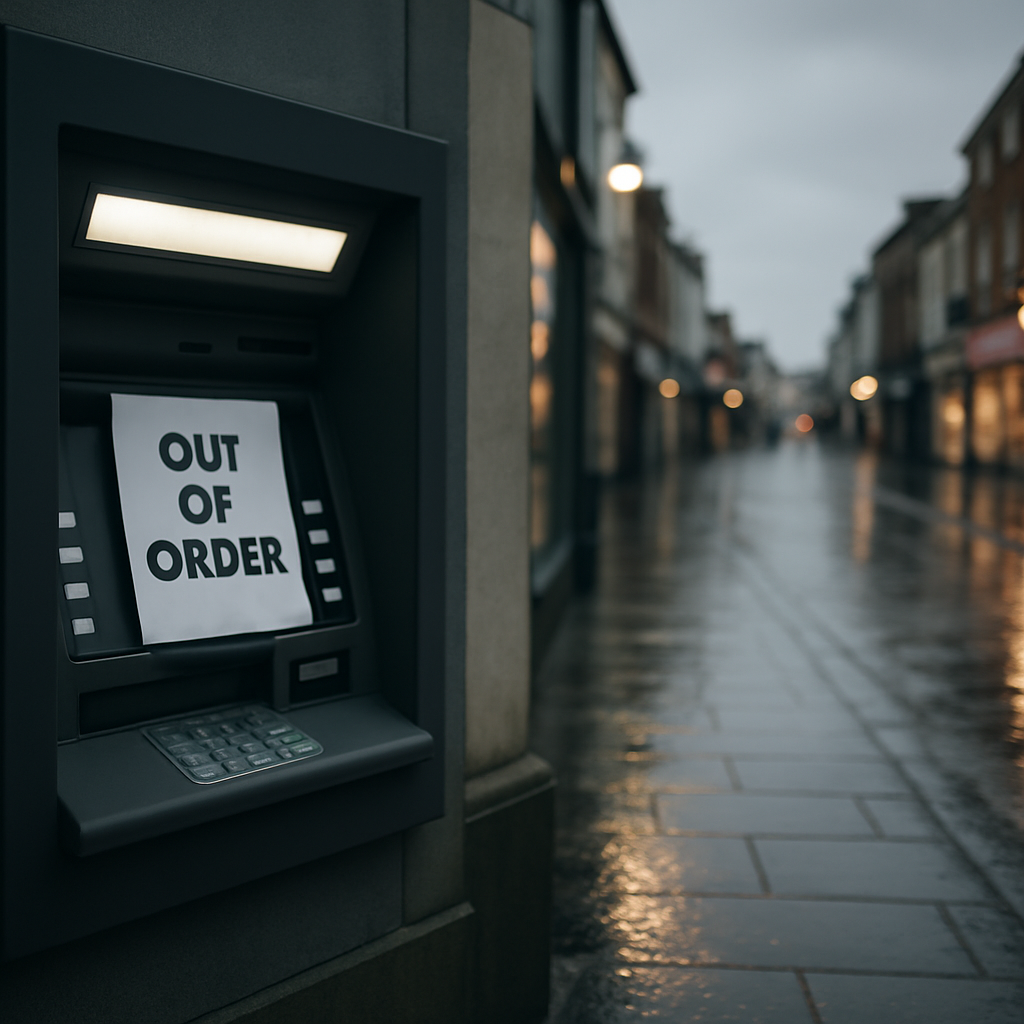
Where Have All the Cash Machines Gone?
The decline of the free ATM is not accidental. It is a commercial decision. Banks have been quietly closing branches for years, and with them go the machines. LINK, which runs the UK’s largest ATM network, has reported consistent year-on-year reductions in the number of fee-free machines. Many that remain have been converted to pay-to-use, charging users between £1.50 and £2 per withdrawal. In some areas, the nearest free machine is now over a mile away. For someone with limited mobility, that is not an inconvenience. It is a barrier.
The government promised action. The Financial Services and Markets Act 2023 introduced legal duties on the FCA to protect access to cash, and the FCA has been slowly rolling out requirements for banks to conduct local assessments before closing branches. But enforcement has been sluggish, and the closures keep coming. The Post Office has stepped in as a partial substitute, allowing customers to withdraw cash over the counter. It helps, but it is not enough, and Post Office hours are often shorter than people expect.
Who Is Actually Being Hurt by the Cashless Society UK Trend?
Oli and I have spoken about this one quite a bit, because it is easy to dismiss if you are young, have a smartphone, and a contactless card in your wallet. For us, the cashless society UK shift is mostly painless. But think about who it is not painless for.
Around 1.1 million adults in the UK have no bank account at all, according to the Financial Conduct Authority. They include people leaving care, those with poor credit histories, recently arrived migrants, and individuals who have simply never trusted the banking system. For these people, cash is not a preference. It is the only mechanism they have for paying for things. A world without cash is a world where they cannot participate in basic commerce.
Then there are older people. Age UK estimates that around 2.4 million people aged 65 and over rely on cash for the majority of their everyday spending. Many do not own a smartphone or do not feel confident using one. Contactless and app-based payments can feel alien and unsafe, particularly for those targeted repeatedly by fraud. When shops stop accepting notes, these individuals are not just inconvenienced. They are excluded.

Disability adds another layer. Blind and partially sighted people rely on the tactile differences between bank notes to identify denominations. People with certain cognitive impairments find digital transactions confusing and difficult to track. For those with conditions affecting fine motor control, tapping a card or navigating a payment terminal can be a genuine physical challenge. The Royal National Institute of Blind People (RNIB) has repeatedly warned that a cashless society UK risks creating a two-tier system where accessibility becomes an afterthought.
The Businesses Refusing Cash, and Why They Do It
Businesses that go cashless are not doing it to be cruel. They do it because it is cheaper to operate, faster at the till, and reduces the risk of theft. Cash handling costs money. Counting it, bagging it, taking it to the bank. For a small café running on tight margins, it makes commercial sense. That is understandable. But understanding the logic does not make the outcome any less damaging for those without alternatives.
Some venues have gone even further, adopting app-only ordering systems, particularly at music venues, sports grounds, and tourist attractions. Try ordering a pint at some Premier League grounds and you will need a card or your phone. No cash accepted. No exceptions. It has a creeping normalisation to it that makes it easy to miss how radical the change actually is.
There is currently no law in England and Wales requiring businesses to accept cash. Scotland and Northern Ireland operate under slightly different arrangements but the picture is broadly similar. The UK has no legal tender obligation on retailers, unlike some European countries, which means businesses can refuse cash entirely and face no penalty for doing so.
What Can Actually Be Done?
A number of campaigners and charities have called for a legal right to pay in cash, at least for essential goods and services. The argument is straightforward: if you can legally earn or receive money in the form of notes and coins, you should be able to spend it. Others want stricter enforcement of the FCA’s existing access-to-cash duties and a faster rollout of banking hubs, shared physical spaces where multiple banks offer basic services under one roof. A handful of these hubs are now open in places like Rochford, Cambuslang, and Brixham, but the rollout has been painfully slow against the scale of the problem.
Digital literacy programmes also have a role to play. Helping older and less confident users get comfortable with banking apps and contactless payments is genuinely useful, and organisations like Age UK and Citizens Advice do excellent work in this space. But digital inclusion can only go so far when the underlying infrastructure, reliable broadband, affordable devices, accessible interfaces, is still out of reach for many.
For small publishers and digital-first outlets like ours at The oz0ne, being online is second nature. Running a free SEO checker or managing a digital subscription feels normal because we live in that world. But not everyone does. And assuming that everyone can simply adapt to a digital-first economy is, frankly, a failure of empathy dressed up as progress.
Britain Is Not Ready to Go Cashless Yet
The cashless society UK debate is often framed as a binary choice between old and new, between those who fear change and those who embrace it. That is far too simple. Most people are not arguing against digital payments. They are arguing against the removal of alternatives before the infrastructure and support systems exist to make digital payments universally accessible.
Closing ATMs, allowing cash refusals, shrinking branch networks, and under-resourcing banking hubs while millions of people still depend on physical money is not modernisation. It is negligence. The UK can absolutely move toward a more digital economy, but it has a duty to make sure that nobody gets cashless and cut off in the process.
Frequently Asked Questions
Is it legal for UK shops to refuse cash?
Yes, in England and Wales there is no legal requirement for businesses to accept cash as payment. Retailers can choose to go cashless entirely without breaking any law, which is why campaigners are pushing for legislation to protect the right to pay with notes and coins for essential goods.
How many free ATMs are left in the UK?
The number has fallen significantly, dropping by more than 10,000 since 2018. Many remaining machines now charge a fee of between £1.50 and £2 per withdrawal, particularly in rural and lower-income areas where free machines have largely disappeared.
Who is most affected by the move to a cashless society in the UK?
The elderly, disabled people, and the roughly 1.1 million adults with no bank account are most at risk. Around 2.4 million over-65s rely on cash for most spending, while blind and partially sighted people depend on the physical feel of notes to identify denominations.
What is the UK government doing to protect access to cash?
The Financial Services and Markets Act 2023 placed duties on the FCA to maintain reasonable access to cash across the UK. The FCA can now require banks to assess local needs before closing branches, and a network of shared banking hubs is being gradually rolled out, though progress has been slow.
What is a banking hub and are there any near me?
A banking hub is a shared branch space where several banks offer basic in-person services under one roof, typically replacing multiple closed individual bank branches in a town. A small number are now operating in places like Rochford, Cambuslang, and Brixham, with more planned, but coverage remains limited compared to demand.