

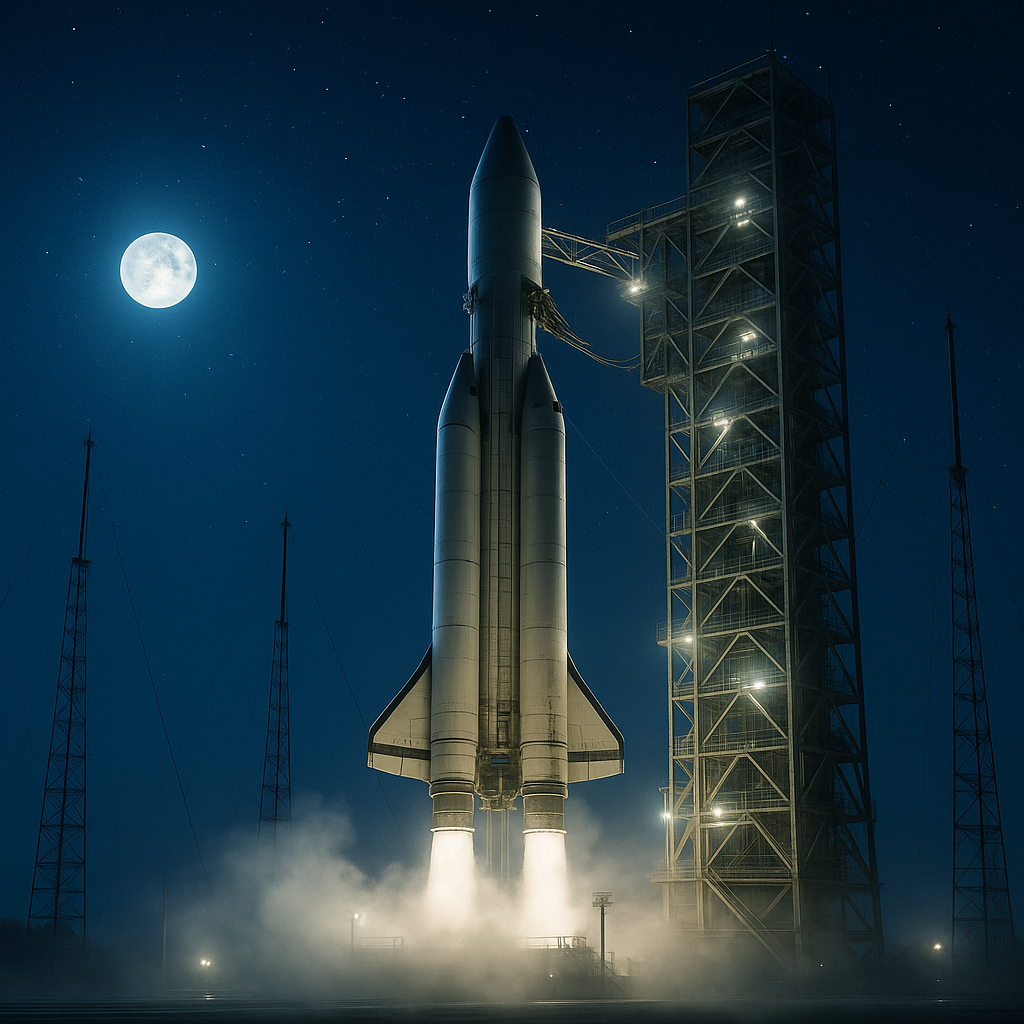
Space is busy again. Properly, dramatically, historically busy. The new space race 2026 looks nothing like the Cold War posturing of the 1960s, yet it carries just as much geopolitical weight, just as much national pride, and considerably more rocket launches per year. Governments are spending billions, private companies are sprinting to keep up, and the Moon, which we visited more than half a century ago and then largely ignored, has become the most contested piece of real estate in the solar system.
So what is actually happening up there, who is pulling ahead, and should anyone down here on the ground care? The short answer is yes, quite a lot. Let’s break it down.
The Moon Is Back on Everyone’s Agenda
NASA’s Artemis programme has had a bumpy ride, to put it politely. Artemis I launched without a crew in late 2022 and completed a successful lunar flyby. Artemis II, carrying four astronauts including Canadian and British-trained crew members, was scheduled for a crewed lunar orbit in 2025 but slipped into 2026 due to heat shield issues discovered during post-flight analysis. The actual crewed landing, Artemis III, is now targeting 2027 at the earliest. It is behind schedule, over budget, and still the most ambitious crewed spaceflight programme on the planet.
China, meanwhile, is moving with the kind of quiet efficiency that makes the rest of the world uncomfortable. The China National Space Administration has committed to landing taikonauts on the Moon before 2030, a goal that most independent analysts believe is credible rather than boastful. China’s Chang’e 6 mission, which returned samples from the Moon’s far side in 2024, was a genuine world first. No one had ever retrieved material from that part of the lunar surface before. It was a remarkable piece of engineering and a very deliberate statement of intent.
SpaceX, Blue Origin, and the Private Sector Scramble
The commercial angle of the new space race 2026 is where things get genuinely strange and genuinely exciting in equal measure. SpaceX’s Starship is the vehicle everyone is watching. After a series of spectacular test flights, some of which ended in spectacular fireballs, the programme achieved full booster catch and reuse in late 2024. By 2026, Starship has completed multiple successful test missions and remains the nominated lander for NASA’s Artemis III. It is also the rocket SpaceX needs to make Mars a realistic proposition within the decade, at least on Elon Musk’s timeline, which historically needs a liberal application of scepticism.
Jeff Bezos’s Blue Origin finally got its New Glenn rocket properly operational in 2025 after years of delays. It is competing for government and commercial launch contracts and, unlike SpaceX, Blue Origin has tended to keep a lower profile. That suits them fine. Meanwhile, the UK’s own Skyrora and Orbex are still working toward orbital launches from Scottish soil, with Orbex’s Prime rocket targeting Sutherland’s Space Hub. It is small-scale compared to the American giants, but a UK orbital launch would be a significant milestone for British aerospace. The BBC has covered the progress of the Sutherland site extensively, and you can read more about British spaceflight ambitions at BBC Science and Environment.
Why the Moon Matters More Than You Might Think
People sometimes ask why anyone is bothering to go back. We went, we planted flags, end of story. But the modern interest in the Moon is not about planting flags. It is about water ice, specifically the deposits confirmed at the lunar south pole. Water ice means drinkable water, breathable oxygen, and hydrogen fuel, all without shipping it from Earth at enormous cost. Whoever establishes a sustainable presence at the lunar south pole will have a significant strategic and logistical advantage for deeper space missions.
The US and its international partners, including the European Space Agency and JAXA in Japan, have formalised this ambition through the Artemis Accords, a set of principles for peaceful and transparent space exploration. China and Russia have declined to sign up and are developing their own International Lunar Research Station programme instead. Two distinct visions, two distinct alliances. The geopolitics of Earth have been copy-pasted directly onto the Moon’s surface, which tells you everything about how seriously governments are taking this.
Mars Is Still the Big Bet
SpaceX talks about Mars with the same casual confidence that other companies use to announce a new product line. Musk has long stated his goal of establishing a self-sustaining city on Mars, and while that remains firmly in the realm of science fiction for now, the groundwork is being laid. NASA’s Perseverance rover has been collecting samples on the Martian surface since 2021, with a planned Mars Sample Return mission intended to bring those samples back to Earth. The cost and timeline of that mission have become a serious headache for NASA, and some form of restructuring is expected.
China has also landed on Mars, with the Tianwen-1 mission deploying the Zhurong rover in 2021. Planning for a Chinese Mars sample return mission is reportedly underway. The new space race 2026 is therefore not just about the Moon. Mars ambitions are shaping procurement decisions, engineering choices, and budget battles across multiple space agencies right now.
It is worth noting how terrestrial this all feels when you zoom out. The competition for space dominance mirrors competition in other arenas, whether that is chip manufacturing, undersea cables, or, closer to home, the kind of rugged capability development you see in industries built around extreme environments. People who work in demanding physical sectors, from off-road vehicle engineering to military logistics, often follow aerospace developments closely because the engineering lessons travel. If you are into serious vehicle capability, the conversations around chassis engineering for extreme terrain, like those behind Toyota 4×4 Chassis Upgrades, reflect a similar obsession with reliability under pressure that drives space hardware design.
Who Is Actually Winning the New Space Race?
It depends what you mean by winning. On raw launch cadence, SpaceX is untouchable. The company is conducting more orbital launches than the rest of the world combined, most years running. On government programme ambition, the US still leads through Artemis and its network of international partners. On speed and determination, China is making the most convincing gains. The CNSA is meeting its stated milestones with a consistency that US programme managers are watching very carefully indeed.
For the UK specifically, the stakes are real but the role is more collaborative than competitive. British companies supply components for ESA missions, British scientists are involved in planetary research, and the ambition for a domestic launch capability from Scotland remains alive. The UK Space Agency’s annual report consistently highlights growth in the British space sector, which employs around 50,000 people and contributes roughly £17.5 billion to the economy.
The new space race 2026 is not a single competition with a finishing line. It is a sustained, multi-decade effort across dozens of actors, public and private, national and international. The first country to establish a permanent lunar presence will not have won a race. They will have opened a new chapter entirely. And given the pace of progress over the last three years, that chapter might not be as far away as it seemed.
Frequently Asked Questions
What is the new space race and who is involved?
The new space race refers to the renewed international competition to explore and establish a presence in space, particularly on the Moon and Mars. Key players include NASA and its Artemis partners, China’s CNSA, private companies like SpaceX and Blue Origin, and the European Space Agency.
Is China ahead of the US in the space race in 2026?
Not overall, but China is closing the gap significantly. The US still leads on launch volume and crewed spaceflight experience, but China’s Chang’e lunar missions and credible 2030 crewed Moon landing timeline have shifted expert assessments of the rivalry considerably.
What role does the UK play in space exploration?
The UK contributes through ESA partnerships, a growing domestic space industry employing around 50,000 people, and ambitions to conduct orbital launches from the Sutherland Space Hub in Scotland. The UK Space Agency also funds research missions and technology development.
Why does everyone want to go back to the Moon?
The main driver is the discovery of water ice at the lunar south pole, which could provide fuel, water, and oxygen for long-duration missions. Establishing a presence there would give a major strategic and logistical advantage for future deep space exploration, including missions to Mars.
When will humans land on Mars?
No firm crewed Mars landing date exists yet. SpaceX has ambitious internal targets suggesting the late 2020s or early 2030s, but most space agency experts consider the mid-to-late 2030s a more realistic window, dependent on Starship’s development and funding commitments.
Leave a Reply