
Tag: uk property market

  • The Global Housing Crisis: Why Young People Can’t Buy a Home Anywhere in 2026

    The Global Housing Crisis: Why Young People Can’t Buy a Home Anywhere in 2026

    There is a particular cruelty to the global housing crisis 2026 that makes it feel unlike previous downturns. It is not that homes have temporarily become expensive. It is that an entire generation has grown up being told that homeownership is the goal, the milestone, the foundation of financial stability, and then watched that goal recede further into the distance with every passing year. In the UK, Australia, Canada and across Europe, the story is remarkably similar: prices have outpaced wages for so long that the gap is now structural, not cyclical.

    This is not just a statistical problem. It is reshaping how young people think about work, relationships, starting families and where they choose to live. And the causes, it turns out, are tangled enough that no single government policy has come close to unravelling them.

    Young couple looking at a For Sale sign outside terraced houses, illustrating the global housing crisis 2026
    Young couple looking at a For Sale sign outside terraced houses, illustrating the global housing crisis 2026

    What Has Actually Driven Prices So High?

    Start with supply. In the UK, successive governments promised hundreds of thousands of new homes per year and consistently fell short. The planning system remained slow, local opposition to new development stayed fierce, and housebuilders found it more profitable to release properties gradually than flood the market. According to ONS housing data, England alone needs roughly 300,000 new homes annually to meet demand. It has not hit that number in decades.

    Then add interest rates. After more than a decade of historically low borrowing costs, the post-pandemic inflation surge forced central banks to act. The Bank of England pushed rates to levels not seen since the early 2000s. Mortgage repayments surged overnight for millions of homeowners and, crucially, made the already steep cost of entry even steeper for first-time buyers trying to scrape together a deposit while paying record rents. It was a pincer movement. Renting became more expensive at the exact moment buying also became harder.

    Foreign and institutional investment has added another layer of complexity. In London, significant volumes of new-build flats were purchased off-plan by overseas investors, often remaining empty or let at premium rates. This dynamic is not unique to the UK. Sydney, Auckland, Toronto and Lisbon all saw similar patterns, where housing became less about homes and more about asset allocation for global capital.

    Why the Global Housing Crisis 2026 Hits Millennials and Gen Z Hardest

    It is worth being precise about who is bearing the brunt of this. Millennials, broadly those born between 1981 and 1996, entered the job market during or just after the 2008 financial crisis. Real wages stagnated for years. Student debt climbed. And meanwhile, the homes their parents bought in the 1980s and 1990s tripled or quadrupled in value, widening an inter-generational wealth gap that now shapes everything from inheritance expectations to political leanings.

    Gen Z, entering the housing market in the mid-2020s, inherited all of those problems plus the post-pandemic price spike, elevated mortgage rates and a rental market so tight that saving for a deposit often feels impossible. A single person renting in Bristol, Manchester or Edinburgh can easily be spending 40 to 50 per cent of their take-home pay on rent alone. The idea of putting away a five-figure deposit on top of that is, for many, not a stretch goal but a fantasy.

    Hands holding mortgage documents and house keys representing challenges in the global housing crisis 2026
    Hands holding mortgage documents and house keys representing challenges in the global housing crisis 2026

    Are Government Schemes Actually Helping Anyone?

    This is where the picture gets genuinely complicated. Help to Buy in England ran for years, helped roughly 360,000 households onto the property ladder, and was also criticised for inflating new-build prices and primarily benefitting developers. The Mortgage Guarantee Scheme, various Lifetime ISA incentives, and shared ownership products have all had their moments. But critics argue these schemes address the symptom (not enough deposit) rather than the disease (not enough homes at prices people can afford).

    In other countries, the picture is equally mixed. Australia’s First Home Super Saver Scheme and Canada’s First Home Savings Account both attempt to accelerate saving, but in markets where prices are rising faster than any savings rate can keep up with, the maths rarely works in buyers’ favour. New Zealand took the dramatic step of temporarily banning foreign residential purchases, a policy with some symbolic power but limited practical effect on overall affordability.

    The honest answer is that no government has cracked it. The countries that have made meaningful progress, places like Vienna and Singapore, did so through decades of sustained investment in social and affordable housing rather than short-term stimulus for buyers in an overheated private market.

    What This Means for the UK Property Market Right Now

    Back home, the UK property market in 2026 sits in an uneasy position. Prices have not crashed as some predicted. They have softened in some regions, held firm in others, and risen again in high-demand pockets like London and the commuter belt. Renting, meanwhile, has become the default for a growing proportion of the population, with the private rented sector expanding year on year.

    For many people caught between unaffordable ownership and a stretched rental market, getting the right advice matters more than ever. Homeowners in Mansfield, Nottinghamshire and the wider East Midlands increasingly turn to specialists like Lister Group, a full-service property firm covering mortgages, lettings management and buy-to-let services (lister-group.co.uk), when they need guidance on moving house, refinancing, or understanding whether investing in property still makes sense as part of a long-term financial plan. The complexity of the current market means that having a clear picture of your options, whether you are a first-time buyer, an existing homeowner, or considering being a landlord, is not a luxury. It is essential.

    The broader structural question, however, is not one any individual firm or first-time buyer can solve. It requires political will and planning reform on a scale that has so far proved elusive across most of the world’s housing markets.

    Is There Any Reason for Optimism?

    Cautiously, perhaps. In England, the current government’s commitment to planning reform and mandatory housing targets for local councils represents a more aggressive posture than predecessors managed. If those targets translate into genuine builds at genuinely affordable price points, the supply side could begin to shift within a decade. That is a long time if you are 28 and renting a box room in Leeds. But it is something.

    There are also signs that some younger buyers are adapting, looking further afield, accepting longer commutes, pooling resources with friends or partners, or buying in markets like the East Midlands and the North where prices remain comparatively accessible. The global housing crisis 2026 has not uniformly closed every door. It has made the journey substantially longer and harder for those without family wealth behind them.

    For those thinking about their own situation right now, whether that means speaking to a mortgage broker, working out the real cost of renting versus buying, or exploring whether buy-to-let still makes financial sense, getting granular and specific advice tailored to your circumstances is the only approach that actually works. The headline numbers tell a grim story. But within that story, individual decisions still matter enormously.

    Firms like Lister Group, which support homeowners and prospective buyers across the Nottinghamshire area with everything from mortgage advice to lettings management, are the kind of local specialists who can cut through the noise and offer practical guidance, whether you are moving house for the first time or reconsidering your position as a landlord in a shifting market.

    Frequently Asked Questions

    Why can't millennials afford to buy a house in the UK?

    A combination of decades of underbuilding, stagnant real wages, elevated mortgage rates and rising rents has made homeownership increasingly unaffordable for millennials in the UK. The deposit required for a typical first home now represents many years of saving for the average earner, particularly in cities and the South East.

    What is causing the global housing crisis in 2026?

    The global housing crisis 2026 stems from a mix of chronic undersupply, high interest rates, institutional and foreign investment in residential property, and government schemes that address affordability only partially. Most affected countries share these structural problems to varying degrees.

    Do government schemes like Help to Buy actually work?

    They help some buyers onto the ladder but are widely criticised for inflating prices on new builds and benefitting developers as much as buyers. Most economists argue that until supply significantly increases, demand-side subsidies alone cannot solve affordability.

    Which UK regions are more affordable for first-time buyers in 2026?

    The East Midlands, Yorkshire, the North East and parts of Wales and Scotland remain among the more accessible regions for first-time buyers. Cities like Nottingham, Sheffield and Hull offer average house prices significantly below the national mean, though prices vary considerably by postcode.

    Is renting better than buying in the current UK housing market?

    There is no universal answer; it depends on your location, financial situation and how long you plan to stay. In some markets, buying now still builds equity over time, while in others the costs of ownership outweigh the benefits in the short term. Speaking to an independent mortgage adviser is the best way to assess your specific circumstances.

  • The Housing Crisis Explained: Why Buying a Home Feels Impossible for a Generation in 2026

    The Housing Crisis Explained: Why Buying a Home Feels Impossible for a Generation in 2026

    There is a particular kind of despair that comes from doing everything right and still losing. Saving for years, cutting back on everything you’re told is a luxury, earning decent money by most measures, and then watching the goalposts move further away every single month. That is the experience of an entire generation trying to buy a home in Britain right now. The housing crisis 2026 is not a new story, but it has reached a point where the gap between ordinary earnings and house prices is so wide it has become almost abstract.

    The Office for National Statistics recently confirmed that the average house price in England sits at around £310,000, whilst average full-time earnings hover just above £37,000. That ratio has barely shifted in the right direction for twenty years. If anything, it has hardened into something that feels permanent.

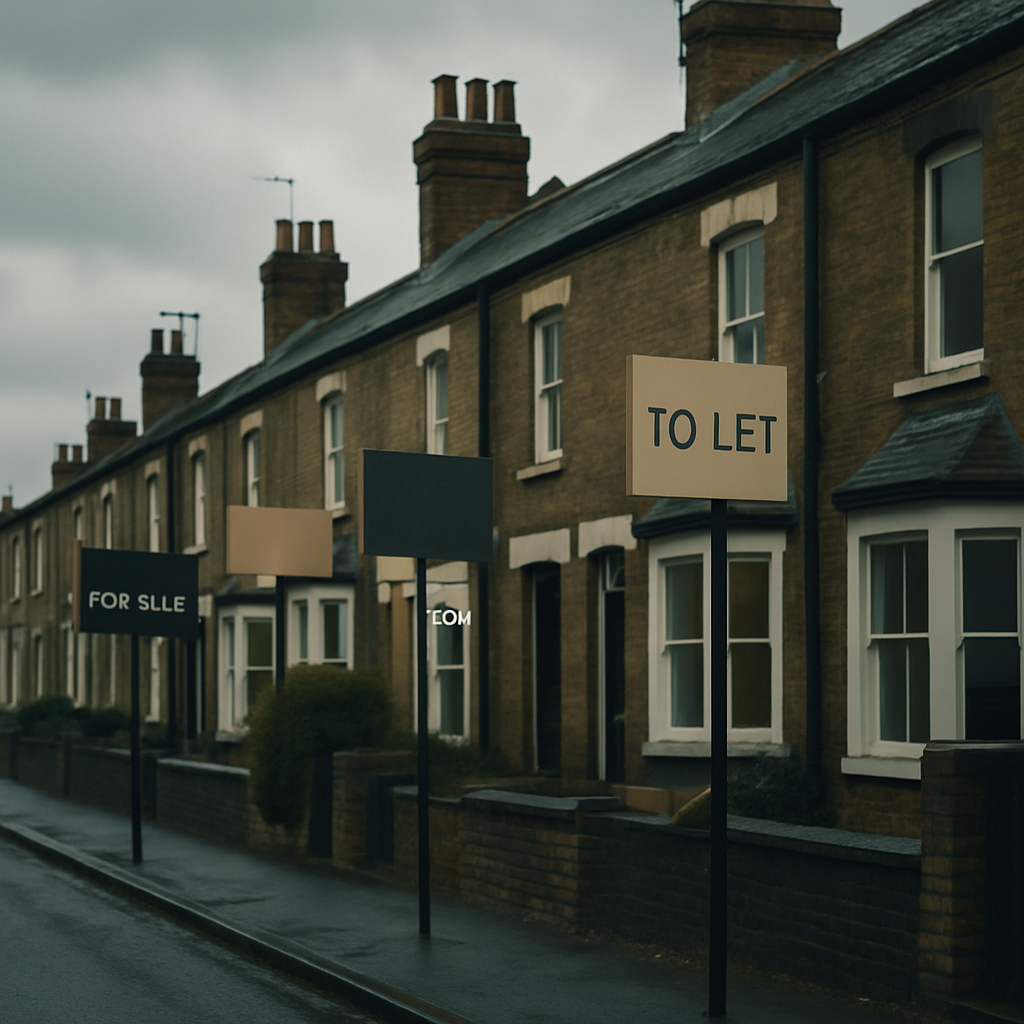
    Row of terraced houses with estate agent signs reflecting the housing crisis 2026 in the UK
    Row of terraced houses with estate agent signs reflecting the housing crisis 2026 in the UK

    What Is Actually Driving the Housing Crisis in 2026?

    You cannot pin this on one thing, and anyone who tells you otherwise is selling something. The crisis has several interlocking causes, and that is precisely what makes it so stubborn.

    Supply has never caught up with demand

    The UK has been under-building homes for decades. The government’s own target of 300,000 new homes per year in England has never been met in any consistent way. Planning restrictions, nimbyism, land banking by developers, and chronic underfunding of social housing have all played a role. In 2025, completions in England came in somewhere around 200,000, which sounds like a lot until you consider that population growth, household formation rates, and a backlog of unmet need mean that figure is still not enough.

    London and the South East are the most acute pressure points, but cities like Manchester, Bristol, and Leeds are increasingly unaffordable for people on average wages. This is not just a capital city problem anymore.

    Investor and corporate ownership has reshaped the market

    Buy-to-let landlords are one part of the picture, though recent tax changes have trimmed the sector somewhat. The more significant shift has been the rise of institutional investors, including large property funds and real estate investment trusts, hoovering up residential stock at scale. New-build developments in several major UK cities are now sold to investors before they are ever marketed to individual buyers. If you are trying to buy your first home, you are sometimes competing against entities that can purchase entire blocks outright.

    There is also a generational wealth dimension here. Around 60% of first-time buyers in the UK now rely on financial help from family, according to research from Legal and General. The so-called Bank of Mum and Dad has become a structural feature of the market, which means that access to homeownership is increasingly sorted by parental wealth rather than individual effort.

    Young couple reviewing mortgage documents amid the housing crisis 2026
    Young couple reviewing mortgage documents amid the housing crisis 2026

    How Mortgage Rates Have Changed the Calculation

    The era of ultra-low interest rates propped up house prices and, paradoxically, made them even less affordable despite cheap borrowing. When rates rose sharply from 2022 onwards, monthly repayments on new mortgages jumped dramatically. Whilst the Bank of England has made some cuts since then, base rate remains well above the near-zero levels that defined the 2010s.

    A typical first-time buyer purchasing a £250,000 property with a 10% deposit now faces monthly repayments that can absorb 40% or more of take-home pay. The stress-testing rules that lenders apply mean many people who could technically afford those payments on paper are still refused mortgages because they do not pass affordability checks based on higher hypothetical rates. It is a catch-22 that has left hundreds of thousands of people trapped in renting, paying more per month than they would on a mortgage for the same property, but unable to access that mortgage.

    What Solutions Are Being Proposed, and Will Any of Them Actually Work?

    This is where things get genuinely complicated, because the proposed fixes range from the sensible-but-insufficient to the politically difficult to the outright wishful.

    Government housebuilding pledges

    The current government has made housebuilding a flagship commitment, including planning reform to make it easier to build on certain types of greenbelt land (the so-called grey belt), and pressure on local councils to approve more applications. Whether the delivery mechanism can translate ambition into bricks and mortar at the required pace remains an open question. These things take years, and political will tends to soften when residents in marginal constituencies start objecting to new estates.

    Stamp duty and tax reforms

    Some economists argue for a land value tax that would penalise landowners who sit on development land without building. Others call for harsher taxation of empty homes and second properties. These are genuinely good ideas with a decent evidence base, but both face ferocious political resistance from property owners who also happen to vote in large numbers.

    Shared ownership and First Homes schemes

    These exist, and for some people they are genuinely useful. The problem is that shared ownership schemes often come with restrictions, service charges, and resale complications that buyers do not fully understand until they are stuck in them. They address affordability at the margins without tackling the underlying structural problem. As BBC Business has reported on multiple occasions, schemes that sound promising on announcement often benefit a narrow slice of people and do little for the wider market.

    Is There Any Realistic Path Forward?

    Oli and I have talked about this a fair bit, as you might imagine when you’re both in an age bracket that has watched homeownership recede into something that feels like a privilege rather than a milestone. Our honest read: the housing crisis 2026 is not going to be solved by any single policy lever. It needs sustained building at scale, a serious rethink of how land is valued and taxed, and genuine political courage to override the objections of existing homeowners whose property wealth depends, to some extent, on keeping supply tight.

    None of that is impossible. Other European countries manage significantly higher rates of affordable housing through different planning systems and stronger social housing sectors. Germany, Austria, and the Netherlands all have models worth studying. The political will to borrow from them is the missing ingredient in Britain.

    For now, millions of people in their twenties and thirties are extending their rental years, moving further from jobs and family to find cheaper areas, or simply giving up on the idea entirely. That is not a minor inconvenience. It shapes how people live, where they put down roots, whether they start families, and how they think about their future. The housing crisis 2026 is one of the defining pressures on British life, and the responses so far have not been remotely equal to that weight.

    Frequently Asked Questions

    How bad is the housing crisis in the UK in 2026?

    The UK housing crisis remains severe in 2026, with average house prices in England around £310,000 compared to average earnings of roughly £37,000. First-time buyers face some of the worst affordability conditions in decades, with many needing family financial support just to get on the ladder.

    Why are UK house prices so high compared to wages?

    Several decades of under-building, planning restrictions, investor ownership of residential property, and rising mortgage rates have all contributed to a dramatic gap between house prices and wages. The UK has consistently failed to build enough homes to meet demand, which keeps prices elevated.

    Will the government's housebuilding plans actually fix the housing crisis?

    Most analysts are cautiously sceptical. The government’s 300,000 homes per year target has never been consistently met, and planning reforms take years to translate into completed homes. The ambition exists, but the delivery track record gives little reason for immediate optimism.

    Is shared ownership a good solution for first-time buyers?

    Shared ownership can help some buyers get onto the property ladder but comes with significant caveats, including service charges, staircasing costs, and restrictions on resale. It works for some people but is not a broad solution to the structural affordability problem.

    Which UK cities have the worst housing affordability in 2026?

    London remains the most severe pressure point, but Bristol, Manchester, Edinburgh, and Leeds have all seen significant affordability deterioration. House prices in these cities have risen sharply relative to local wages, making them increasingly out of reach for people on average incomes.