
There are houses in Norfolk that are closer to the sea than they were last year. Not metaphorically. Literally. The cliffs at Happisburgh have been retreating at an average of about one metre per year for decades, and in storm seasons that figure gets considerably worse. Families have watched garden walls go first, then the gardens themselves, and in some cases the road outside. The government’s response, broadly speaking, has been to suggest people think carefully about where they live.
Coastal erosion in the UK is not a new story. But the scale of what is now being acknowledged as inevitable, and the way communities are being quietly asked to accept it, is something that deserves a lot more attention than it gets. From the Norfolk Broads to the Welsh coast, from Yorkshire’s vanishing clifftops to a village in Gwynedd that is being actively dismantled with public money, this is a slow-motion crisis with very real victims.
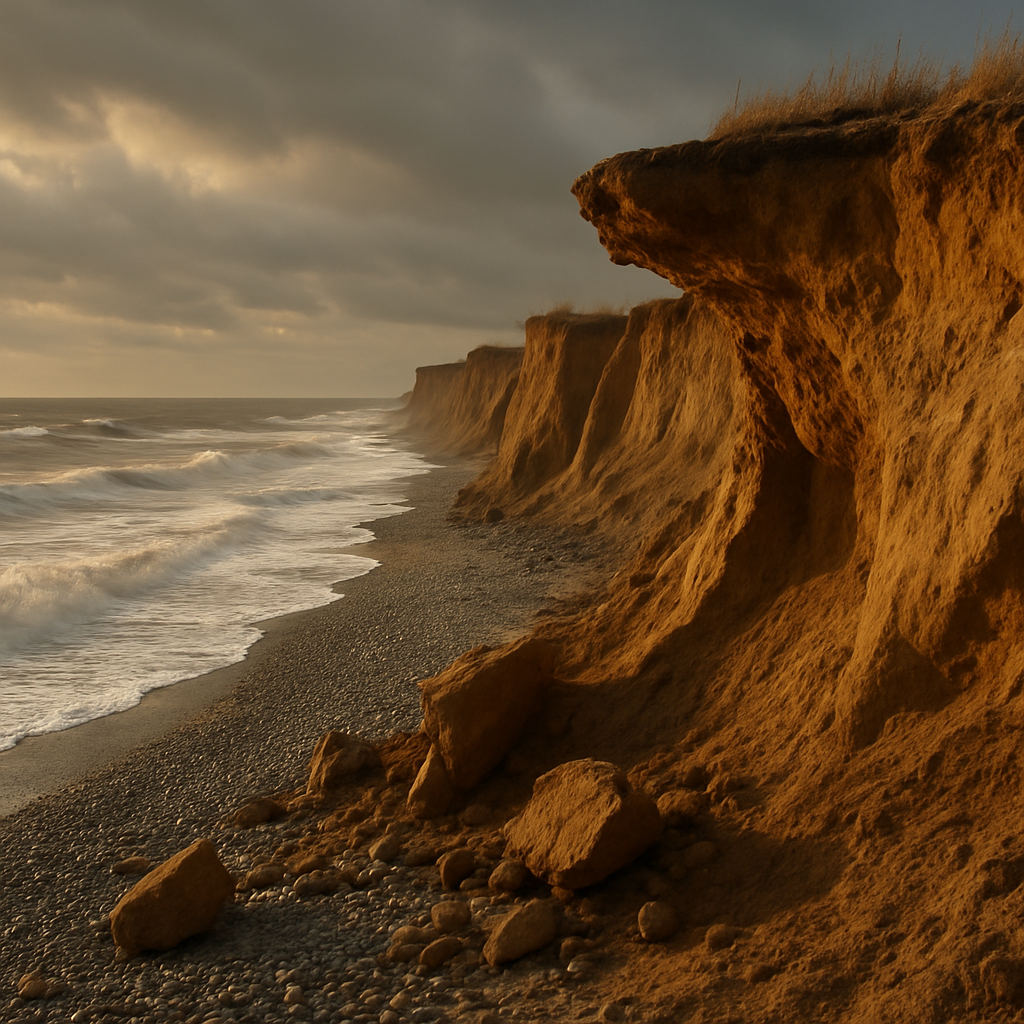
Why Happisburgh Has Become the Symbol of Coastal Erosion in the UK
Happisburgh (pronounced, bafflingly, “Haze-bruh”) sits on the North Norfolk coast and has been losing ground to the North Sea for centuries. What has changed is the pace. The sea defences that once protected the village were effectively abandoned in the 1990s when the government decided the cost of maintaining them outweighed the value of what was being protected. That calculation, coldly economic, left a small community facing an existential threat with very little legal recourse.
Residents who bought homes there had no way of knowing protection would be withdrawn. Some have seen their property values collapse to near zero. Mortgages become impossible to transfer. Insurance is either unavailable or eye-wateringly expensive. And when the cliffs eventually take the house, there is no statutory compensation. You lose it, and that is largely that.
The Environment Agency publishes Shoreline Management Plans, documents that outline what level of coastal defence, or lack thereof, different stretches of coastline can expect over the next century. For a significant number of communities, the plan is classified as “managed retreat” or “no active intervention”. That is the official language. What it means in practice is: we are not going to spend money protecting you, and eventually you will need to move.
What Is Managed Retreat and Who Does It Actually Affect?
Managed retreat is a policy approach where rather than building or maintaining hard defences like sea walls and rock armour, the coastline is allowed to move inland. In some contexts, particularly for salt marshes and low-value agricultural land, it makes genuine ecological sense. Allowing tidal areas to flood naturally can create important habitat and actually help absorb future storm surges.
The problem is when managed retreat is applied to places where people actually live. Fairbourne in Gwynedd is perhaps the most striking current example. A small village of around 850 people has been told by Gwynedd Council that it cannot be defended beyond roughly 2054. Plans are already underway for what is being called “decommissioning” of the village, a term that would be Orwellian if it were not so genuinely sad. Homes, a primary school, local infrastructure: all of it is expected to be dismantled or abandoned within a generation.
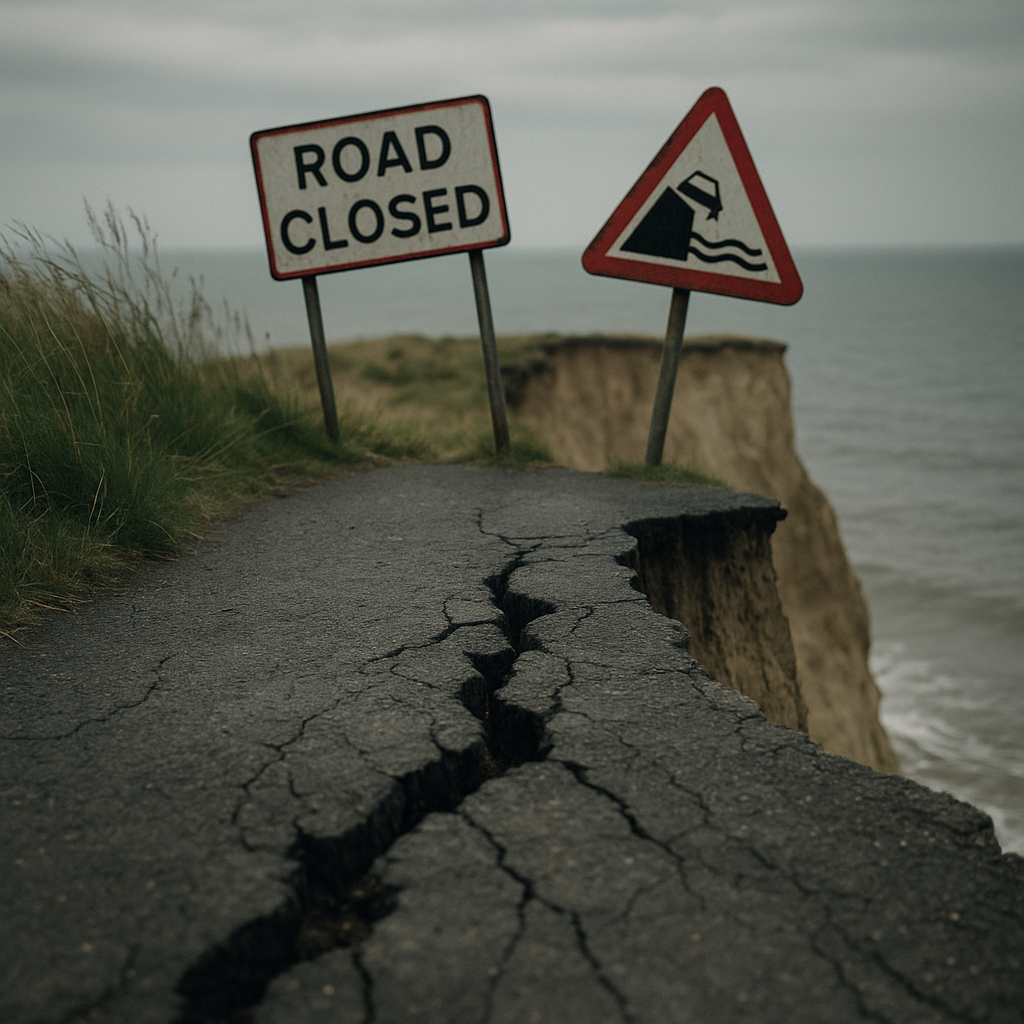
Residents of Fairbourne are understandably furious. Many moved there not knowing any of this was coming, or bought cheap properties without fully understanding the planning context. The Welsh Government has offered some support funding for affected homeowners, but critics argue it falls well short of genuine compensation for losing your home and community. The BBC has covered this extensively, and their reporting on Fairbourne’s fate makes for genuinely sobering reading.
The Holderness Coast and Yorkshire’s Disappearing Clifftops
If Norfolk gets the most press, Yorkshire’s Holderness coast is statistically the fastest-eroding coastline in Europe. The soft boulder clay cliffs between Flamborough Head and Spurn Point lose on average around two metres a year, with some sections going much faster. Entire villages, Ravenser Odd, Auburn, Dimlington, have already vanished. They are not coming back.
Current at-risk settlements include the village of Skipsea, where properties sit within metres of the cliff edge. Bridlington and Hornsea have better defences, but even they face mounting costs to maintain them. The fundamental tension here is one of prioritisation: government and local authority money is finite, and the calculus of whether to spend £20 million on a sea wall protecting 40 homes is uncomfortable but real.
What makes this particularly galling for affected residents is that climate change is accelerating everything. Sea level rise, more frequent and intense storms, wetter winters producing more runoff that saturates cliffs: none of this was factored into property valuations twenty or thirty years ago. The people living through it now were not the ones who failed to plan for it.
Is There Any Support for Families Facing Coastal Loss?
The honest answer is: not much, and what exists is patchy. There is no national scheme specifically designed to compensate homeowners whose properties are lost to coastal erosion. The Coastal Change Pathfinder programme, which ran in the early 2010s, provided some limited funding for pilot projects, but it was never scaled up nationally.
Planning policy has improved in the sense that new-build developments in high-risk coastal areas are now much harder to get approved. But that does nothing for the thousands of people who already own property in these zones. When a home falls into the sea or becomes unsaleable, it simply represents a private financial catastrophe with almost no public safety net attached.
Some community groups have begun using digital tools to document what is happening, creating online archives of disappearing landscapes and organising around lobbying for better compensation frameworks. One such group in Norfolk maintains a website tracking year-on-year cliff changes; they use a straightforward self-hosted setup built on managed WordPress hosting UK providers offer, which keeps the site running reliably even when traffic spikes after a storm event.
What Needs to Change
A cross-party group of MPs raised the issue of coastal erosion compensation in a 2024 Westminster Hall debate, and the government’s response was sympathetic but vague. The phrase “we recognise the very real challenges faced by coastal communities” appeared, which is the parliamentary equivalent of a shrug.
What campaigners are actually asking for is not complicated: a formal compensation mechanism for homeowners who lose property to erosion in areas designated for no intervention; proper advance notice and planning support before properties become worthless; and a genuine national strategy that acknowledges the human cost of managed retreat rather than treating it as an administrative footnote.
None of this is cheap. But the alternative, a patchwork of abandoned communities, devalued properties and traumatised families who had no say in their fate, is its own kind of cost. Britain’s relationship with its coastline has always been complicated. We romanticise it, holiday there, put it on biscuit tins. The least we could do is take seriously what it means when it starts eating itself.
Frequently Asked Questions
Which parts of the UK coastline are most at risk from erosion?
The Holderness coast in East Yorkshire is Europe’s fastest-eroding coastline, losing roughly two metres per year. The North Norfolk coast, particularly around Happisburgh, and parts of the Suffolk and Kent shoreline are also classified as high-risk erosion zones by the Environment Agency.
What does managed retreat mean for homeowners in the UK?
Managed retreat means the government or local authority has decided not to fund sea defences for a particular stretch of coastline, allowing it to erode naturally. For homeowners, this typically means properties become unmortgageable, uninsurable, and eventually unsaleable or physically lost, with very limited statutory compensation available.
Can you get compensation if your home falls into the sea in the UK?
Currently there is no dedicated national compensation scheme for properties lost to coastal erosion. Some limited local authority support has been offered in specific cases, such as Fairbourne in Wales, but homeowners generally have no automatic right to compensation when properties are designated for no coastal defence intervention.